
Northwest Horticultural Council
Export Manual
SOUTH AFRICA
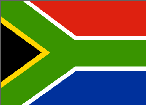 Capital: Pretoria
Population: 60,442,647 (2024)
Currency: Rand
Official Language(s): Afrikaans, English, Zulu, Xhosa, Naebele, Pedi, Sotho, Swazi, Venda, Tsongo
I. CHEMICAL MAXIMUM RESIDUE LEVELS (MRLs)
The NHC’s MRL Database is a resource only available to U.S. growers, packers, and shippers of apples, pears, and sweet cherries who are located in the states of Idaho, Oregon, and Washington, and those that work with them. It is intended to be an initial guide for those U.S. Pacific Northwest companies interested in exporting tree fruit to select markets of interest. Commercially important information should be rechecked and verified with knowledgeable parties in the country of interest prior to sales or shipment. This Database utilizes global MRL data partially funded by the USDA’s Foreign Agricultural Service and managed by FoodChain ID. By accessing and using the NHC’s MRL Database, you acknowledge and agree that you have read and accept the foregoing terms and conditions of use and agree to be bound by them as an express condition to your continued use of the Database.
To access the MRL Database, click here.
II. CHEMICALS AND ADDITIVE INFORMATION
A. Chemical residue standards:
South Africa defers to Codex or the European Union, whichever value is higher. It then defers to its national MRL list. South Africa maintains a default tolerance of 0.01 ppm if no tolerance is listed.
B. Monitoring chemical residues:
The South African Department of Health is the main food regulatory body and approves MRLs for pesticides. Samples are checked often and randomly at the port with perishable items usually processed within two days. Non-compliant goods may be rejected, destroyed, or disposed of outside of South Africa.
C. Restrictions on use of waxes:
None.
III. ORGANIC FRUIT REGULATIONS
No information.
IV. TARIFFS
Fresh apples, pears, and cherries are assessed a duty of 4 percent ad valorem on the FOB value of the fruit.
A 14 percent value-added tax is also assessed on all imports and domestic goods.
V. NON-TARIFF BARRIERS
A. Labeling requirements:
South Africa has a significant number of requirements relating to the grading, packing, and marking (labeling) of apples intended for sale in country. Imported apples may be exempted from some of the South African provisions provided they comply with Codex or UNECE (United Nations Economic Commission for Europe) standards.
South Africa’s regulations may be found here.
UNECE Apple Standards may be found here.
B. Licenses and quotas:
None.
C. Currency Issues:
None.
D. Pest and plant disease restrictions:
Pacific Northwest pears, cherries, and other stone fruits are prohibited from entering South Africa.
Apples from the Pacific Northwest may be exported to South Africa under the terms of the “Protocol of Phytosanitary Requirements for the Export of Apple Fruit From the United States of America, Pacific Northwest States of Washington, Idaho, and Oregon (PNW) to South Africa”. This protocol may be obtained from the Northwest Fruit Exporters (509-453-3193).
Apples must originate from an apple maggot pest-free area in the three Pacific Northwest states.
