
Northwest Horticultural Council
Export Manual
PANAMA
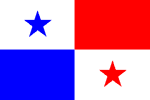 Capital: Panama
Population: 4,470,241 (2024)
Currency: Balboa
Official Language(s): Spanish
I. CHEMICAL MAXIMUM RESIDUE LEVELS (MRLs)
The NHC’s MRL Database is a resource only available to U.S. growers, packers, and shippers of apples, pears, and sweet cherries who are located in the states of Idaho, Oregon, and Washington, and those that work with them. It is intended to be an initial guide for those U.S. Pacific Northwest companies interested in exporting tree fruit to select markets of interest. Commercially important information should be rechecked and verified with knowledgeable parties in the country of interest prior to sales or shipment. This Database utilizes global MRL data partially funded by the USDA’s Foreign Agricultural Service and managed by FoodChain ID. By accessing and using the NHC’s MRL Database, you acknowledge and agree that you have read and accept the foregoing terms and conditions of use and agree to be bound by them as an express condition to your continued use of the Database.
To access the MRL Database, click here.
II. CHEMICALS AND ADDITIVE INFORMATION
A. Chemical residue standards:
Panama follows maximum residue levels established by the Codex Alimentarius Commission. When there is no established Codex MRL, the lowest of the EU or U.S. MRL value is accepted.
B. Monitoring chemical residues:
Panama regularly tests produce for chemical residues.
C. Restrictions on use of waxes:
None.
III. ORGANIC FRUIT REGULATIONS
No information.
IV. TARIFFS
As agreed under the United States-Panama Trade Promotion Agreement, the tariff rate is zero for apples, pears, and cherries from the United States.
V. NON-TARIFF BARRIERS
A. Labeling requirements:
There are no specific labeling requirements for fresh fruits and vegetables. Please check with your importer to ensure compliance.
B. Licenses and quotas:
None.
C. Currency Issues:
The Panamanian economy has been dollarized since 1904.
D. Pest and plant disease restrictions:
A phytosanitary certificate is required. Washington (WA), Oregon (OR), and Idaho (ID) have different requirements that are reflected in the following Additional Declarations (AD). (The common quarantine pest names are listed below.)
Apple: WA AD: “The shipment was inspected and found free from Cydia pomonella,
Diaspidiotus pemiciosus, Eriosoma lanigerum, and Rhagoletis spp.“
OR AD: “The shipment was inspected and found free of Cydia pomonella, Diaspidiotus perniciosus, and Eriosoma lanigerum.”
ID AD: “The shipment was inspected and found free of Eriosoma lanigerum, and Frankliniella occidentalis.”
Pear: WA AD: “The shipment is free of Cydia pomonella and Eriosoma lanigerum.“
OR AD: “The shipment was inspected and found free of Cydia pomonella, Diaspidiotus perniciosus, and Eriosoma lanigerum.”
ID AD: “The shipment is free of Eriosoma lanigerum and Parthenolecanium persicae.”
Cherry: WA place of production only (OR and ID prohibited). No AD listed.
| Latin Names | Common Names |
| Cydia pomonella | codling moth |
| Diaspidiotus perniciosus | San Jose scale |
| Eriosoma lanigerum | wooly apple aphid |
| Frankliniella occidentalis | western flower thrips |
| Parthenolecanium persicae | peach scale |
| Rhagoletis spp | apple maggot, etc. |
VI. MARKETING REPRESENTATIVES FOR PACIFIC NORTHWEST TREE FRUIT INDUSTRY:
Pear Bureau Northwest:
Luis Moreno
Grupo PM S.A. de C.V.
Cuernavaca, Mexico
Voice: +52 777 316 7370
Fax: +52 777 316 7369
E-mail: grupopm@grupopm.com
VII. OTHER RESOURCE LINKS:
Governmental:
VIII. ADDITIONAL COMMENTS
The U.S. and Panama concluded free trade negotiations on December 19, 2006, under which tariffs on U.S. apples, pears, and cherries will be eliminated. This agreement was signed into law by President Obama on October 21, 2011, and entered into force on October 31, 2012.
