
Northwest Horticultural Council
Export Manual
MALAYSIA
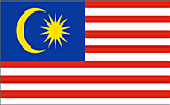 Capital: Kuala Lumpur
Population: 34,564,810 (2024)
Currency: Ringgit
Official Language(s): Bahasa Malaysia
I. CHEMICAL MAXIMUM RESIDUE LEVELS (MRLs)
The NHC’s MRL Database is a resource only available to U.S. growers, packers, and shippers of apples, pears, and sweet cherries who are located in the states of Idaho, Oregon, and Washington, and those that work with them. It is intended to be an initial guide for those U.S. Pacific Northwest companies interested in exporting tree fruit to select markets of interest. Commercially important information should be rechecked and verified with knowledgeable parties in the country of interest prior to sales or shipment. This Database utilizes global MRL data partially funded by the USDA’s Foreign Agricultural Service and managed by FoodChain ID. By accessing and using the NHC’s MRL Database, you acknowledge and agree that you have read and accept the foregoing terms and conditions of use and agree to be bound by them as an express condition to your continued use of the Database.
To access the MRL Database, click here.
II. CHEMICALS AND ADDITIVE INFORMATION
A. Chemical residue standards:
The U.S. Agricultural Attaché in Malaysia has provided the following information regarding the absence of an MRL for many commonly used chemicals:
“Strictly speaking, if a chemical is not listed, it is NOT PERMITTED for use in Malaysia. However, in practice, the absence of a chemical from the approved list may only mean that the Ministry of Health has not yet established a local standard.
Generally, if the chemical does not appear on the approved list at all and there is an established Codex standard, this usually means that Malaysia has simply not established any MRL for the chemical. In this event, they usually will accept Codex or even U.S. standards upon request/review. . . The obvious exception would be if the U.S. standard is even more stringent (than the Codex standard).”
Note: In 2015, Malaysia proposed to formally amend the deferral path as follows: if there is no established national MRL, Codex MRLs will be accepted. If there is no Codex MRL, the MRL established by the Association of Southeast Asian Nations (ASEAN) will be accepted. Malaysia applies a default MRL of 0.01 ppm when no National, Codex, or ASEAN MRL is established. This updated deferral path has not yet been officially adopted.
B. Monitoring chemical residues:
The Ministry of Health is now conducting stringent checks on chemical residues on a number of food products, particularly fresh fruits and vegetables, entering the country. Under the Food Regulations 1985, there is a schedule (Regulation 41) listing permissible levels of pesticide residues on specified food items.
C. Restrictions on use of waxes:
None.
III. ORGANIC FRUIT REGULATIONS
No information.
IV. TARIFFS
The import duty on apples, pears, and sweet cherries is 5 percent ad valorem. In addition to the duty, there is a 5 percent sales tax on fresh pear and cherry imports, but fresh apples are exempted from the sales tax.
V. NON-TARIFF BARRIERS
A. Labeling requirements:
Malaysia’s Federal Agricultural Marketing Authority (FAMA) requires that each carton must be labeled (a sticker may be affixed to the carton) in the national language, Bahasa Malaysia, with the following information:
1. Name and business address of the importer, exporter, agent, producer, distributor – whichever is applicable.
2. Common name (e.g., “apples” or “pears”)
3. Grade
4. Size
5. Country of origin
6. Weight
The labeling information must be contained in an area not less than 11 centimeters by 7 centimeters, in no smaller than 20-point lettering. FAMA accepts U.S. Global Trade Identification Number (G10) or equivalent label size (4 inch x 3 inch or 10 cm x 8 cm).
FAMA no longer provides optional importer name and address submission. Both must appear on the carton label.
The Malaysian importer, or a shipping agent, must use an online system to declare shipment information. Carton label information must be consistent with the import declaration documentation.
FAMA has agreed to accept either the U.S. Government or Washington state grade standards for apples, pears, and cherries. This information, such as U.S. Extra Fancy, U.S. Fancy, U.S. No. 1, must be indicated on the label but it does not need to be translated to native Bahasa Malaysia language.
Example of a label in native Bahasa Malaysia:
– Nama pengimport: Name of the Importer
– Alamat: Address of the Importer
– Nama Pengeksport: Name of the Exporter
– Alamat: Address of the Exporter
– Nama biasa: Common name (of fruit)
– Gred Standard: Standard grade (U.S. Extra Fancy)
– Saiz: Size (fruit count e.g., 113, 138)
– Negara asal: Country of Origin (Amerika Syarikat for USA)
– Berat: Weight
B. Licenses and quotas:
None.
C. Currency Issues:
None.
D. Pest and plant disease restrictions:
None.
VI. MARKETING REPRESENTATIVES FOR PACIFIC NORTHWEST TREE FRUIT INDUSTRY:
Washington Apple Commission:
Eddie Saw
Total Market Solutions
Selangor Darul Ehsan, Malaysia
Voice: 011 603 8070 7216
E-mail: eddie.saw@totalms.com.my
Northwest Cherry Growers/Washington State Fruit Commission:
Malinee Suesuthikul
Diva Studio Co. Ltd.
E-mail: sale.divastudio@gmail.com
Pear Bureau Northwest:
Richard Lieu
Lieu Marketing Assoc Pte Ltd
SINGAPORE
Voice: 011-65-6515 6113
Fax: 011-65-6278 4372
E-mail: lieumktg@singnet.com.sg
