
Northwest Horticultural Council
Export Manual
ECUADOR
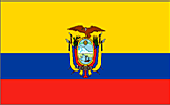 Capital: Quito
Population: 18,309,984 (2024)
Currency: Sucre
Official Language(s): Spanish
I. CHEMICAL MAXIMUM RESIDUE LEVELS (MRLs)
The NHC’s MRL Database is a resource only available to U.S. growers, packers, and shippers of apples, pears, and sweet cherries who are located in the states of Idaho, Oregon, and Washington, and those that work with them. It is intended to be an initial guide for those U.S. Pacific Northwest companies interested in exporting tree fruit to select markets of interest. Commercially important information should be rechecked and verified with knowledgeable parties in the country of interest prior to sales or shipment. This Database utilizes global MRL data partially funded by the USDA’s Foreign Agricultural Service and managed by FoodChain ID. By accessing and using the NHC’s MRL Database, you acknowledge and agree that you have read and accept the foregoing terms and conditions of use and agree to be bound by them as an express condition to your continued use of the Database.
To access the MRL Database, click here.
II. CHEMICALS AND ADDITIVE INFORMATION
A. Chemical residue standards:
Ecuador does not have a national MRL list. It defers first to Codex MRLs, then European Union MRLs, then United States MRLs. Ecuador does not have a national MRL default policy.
B. Monitoring chemical residues:
Ecuador’s National Agricultural Research Institute (INIAP) monitors chemical residues. INIAP is part of the Ministry of Agriculture.
C. Restrictions on use of waxes:
None.
III. ORGANIC FRUIT REGULATIONS
Certificates from accredited institutions are required. For U.S. Products, USDA’s organic certificate is the most reliably recognized certification. Sanitary registration is valid for five years. A new organic certificate is required when renewing the sanitary registration. An apostille certificate must be affixed to the original certificate.
IV. TARIFFS
Apples 15%
Pears 15%
Cherries 25%
V. NON-TARIFF BARRIERS
A. Labeling requirements:
None.
B. Licenses and quotas:
An import permit is required for apples, pears, and cherries.
C. Currency Issues:
None.
D. Pest and plant disease restrictions:
A Phytosanitary Certificate (PC) and import permit are required. Apples, pears, and cherries are prohibited without an import permit. The state of origin must be declared on the PC. Additional declarations stating that “This produce originates in an area free from Bactrocera dorsalis. AND, “The fruit in this shipment has been inspected and found free of Cydia Pomonella and Rhagoletis spp.“
E. Other trade restrictions:
The government of Ecuador requires inspection of products for customs purposes prior to shipment from the country of origin.
VI. MARKETING REPRESENTATIVES FOR PACIFIC NORTHWEST TREE FRUIT INDUSTRY:
Washington Apple Commission:
Ernesto Baron
E-mail: jfernandez@ftainternational.com
Pear Bureau Northwest:
Francesco Sicherle
Produce Marketing Comunicacao e Promocoes
Sao Paulo, Brazil
Voice/Fax: +55 11 3085 6475
Cell: +55 14 8124 9929
E-mail: produce@psi.com.br
